Pickleball serving rules: every legal serve, explained
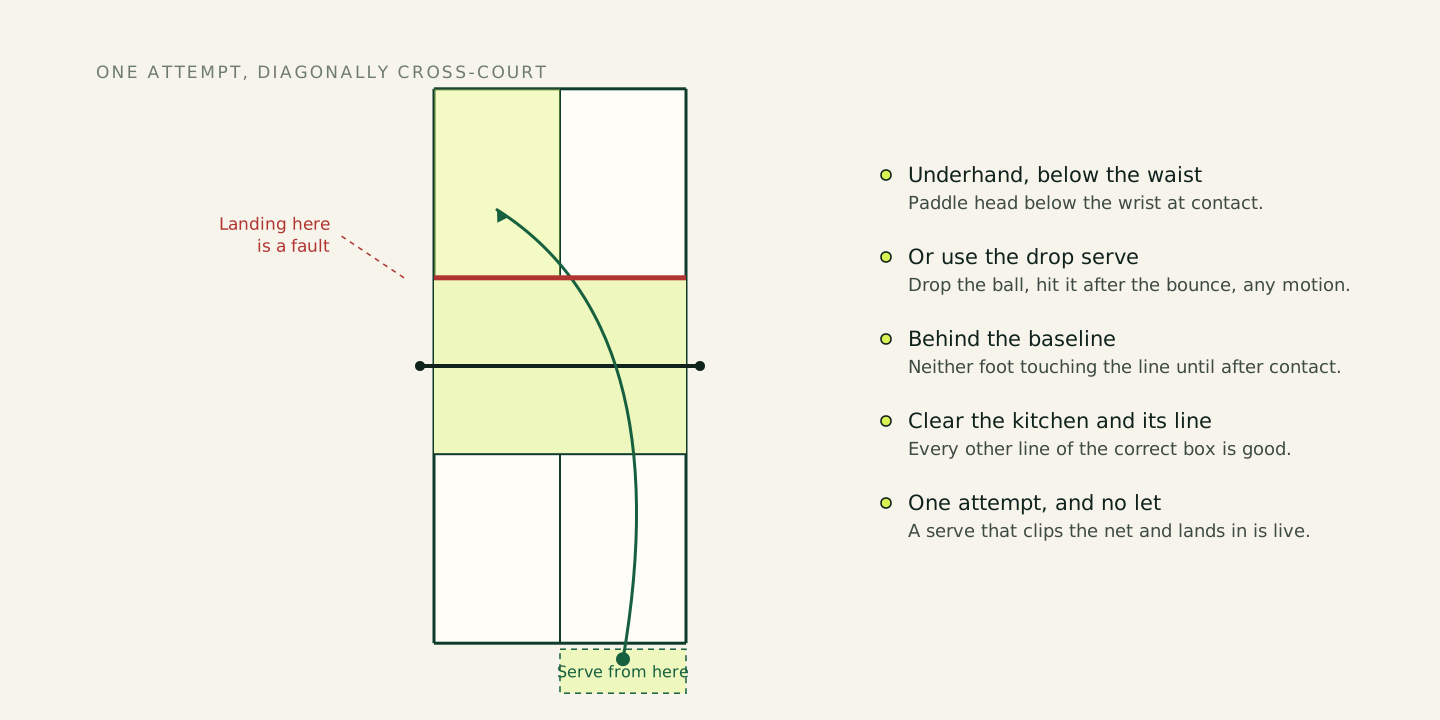
Contact below the waist, paddle head below the wrist. Both conditions, on every volley serve.
Pickleball serving rules changed meaningfully in the last few years, and a lot of what rec players “know” is out of date. There is no let. There is a legal drop serve. And the old chest-high spin serves are gone. This is the current rulebook, in the order you need it.
The two legal serves
There are exactly two, and you may use either on any point.
The volley serve. You strike the ball out of the air, and three conditions all have to hold:
- The swing is upward — an arc travelling from low to high.
- Contact happens below your waist, defined as the navel.
- The highest point of the paddle head is below your wrist joint at the moment of contact.
The drop serve. You drop the ball from your hand — or bounce it off the paddle face — and hit it after it bounces. The ball must fall under its own weight: you cannot throw it down or add force. In exchange, the underhand and contact-height conditions do not apply. You can hit a drop serve with any motion, from any height, off any number of bounces.
The drop serve exists because the volley serve’s conditions are nearly impossible to referee at rec level. It is fully legal, permanently, and there is no advantage claim against players who use it.
Where your feet go
At the moment you hit the ball:
- At least one foot is on the ground behind the baseline.
- Neither foot touches the baseline or the court inside it.
- Both feet are inside the imaginary extensions of the centreline and the sideline.
You may move around behind the baseline as much as you like before contact. Stepping in after you strike is fine — that is the whole point of the serve-and-recover.
Where the serve has to land
Diagonally cross-court, in the service box opposite you. And the serve has one special line rule:
A serve that lands on the kitchen line is a fault. Everywhere else on court, a ball touching a line is in. On the serve, the non-volley zone and its line are out, because the line is part of the zone. Landing on the sideline, centreline or baseline of the correct service court is good.
One attempt, and no let
You get one serve. There is no second serve, and if you fault, you lose the serve.
There is also no let. Before 2021 a serve that touched the net and landed in was replayed; now it is simply live. If it clips the tape and drops in, play it — that ball is in play and counts.
The other replay case does still exist: if the receiver is not ready and signals so before the serve, the serve is replayed with no fault. A receiver cannot claim not-ready after the ball is struck.
Doubles: who serves, and from where
Both partners serve before the serve passes to the other team, except in the first turn of the game. Your position is set by your team’s score — even score serves from the right, odd from the left — and the server number is the third number in the score call.
That whole system, including why the first serve of the game is 0-0-2, is in pickleball scoring.
The two-bounce rule starts here
The serve has to bounce before the receiver may hit it, and the return has to bounce before the serving team may hit it. That means the serving team cannot follow their serve to the net, which is exactly what the rule is for.
It also means the serving team’s third shot is their first free choice of the rally — and that shot decides the point more often than the serve does. See the third shot drop.
Serving faults, in full
- Contact above the waist, or the paddle head above the wrist, on a volley serve.
- Throwing the ball down on a drop serve.
- Touching the baseline or the court before contact.
- Serving from outside the correct half.
- The serve landing out, in the net, in the wrong service court, or on the kitchen line.
- Serving before the score has been called, or calling the wrong score and serving anyway.
- Taking more than 10 seconds after the score is called.
What actually makes a good serve
Legal is the floor. The useful serve is deep — the last three feet of the service box — because a deep serve pushes the receiver back and makes their return shorter. Depth beats pace for rec play, and it beats spin by a wide margin now that the contact-height rules removed most of the spin available.
Common questions
What are the serving rules in pickleball?
The serve must be hit underhand with contact below your waist and the paddle head below your wrist, or dropped and hit after a bounce. You serve from behind the baseline, diagonally cross-court, and the ball must clear the non-volley zone and its line. You get one attempt.
Can the ball hit the net on a serve in pickleball?
Yes. Since 2021 there is no let on the serve. A serve that clips the net and lands in the correct service court is live and must be played. If it lands anywhere else, including on the kitchen line, it is a fault.
Do you get two serves in pickleball like tennis?
No. You get one attempt. If the serve is a fault, you lose the serve — to your partner in doubles if you are the first server, otherwise to the other team.
Where do you stand to serve in pickleball?
Behind the baseline, inside the imaginary extensions of the centreline and the sideline. Neither foot may touch the baseline or the court until after you have struck the ball, and at least one foot must be on the ground behind the baseline at contact.